更长寿
健康医疗知识不断普及、医疗技术持续进步,人类平均寿命达到历史新高。
与此同时,世界卫生组织欧洲区域 60 岁及以上人口数量快速攀升:2021 年为 2.15 亿,预计 2030 年增至 2.47 亿,2050 年将突破 3 亿。其中最需要照护支持的80 岁及以上高龄人群数量到 2050 年将翻倍,给医疗养老体系带来更大压力2。
改善肌肉健康状况
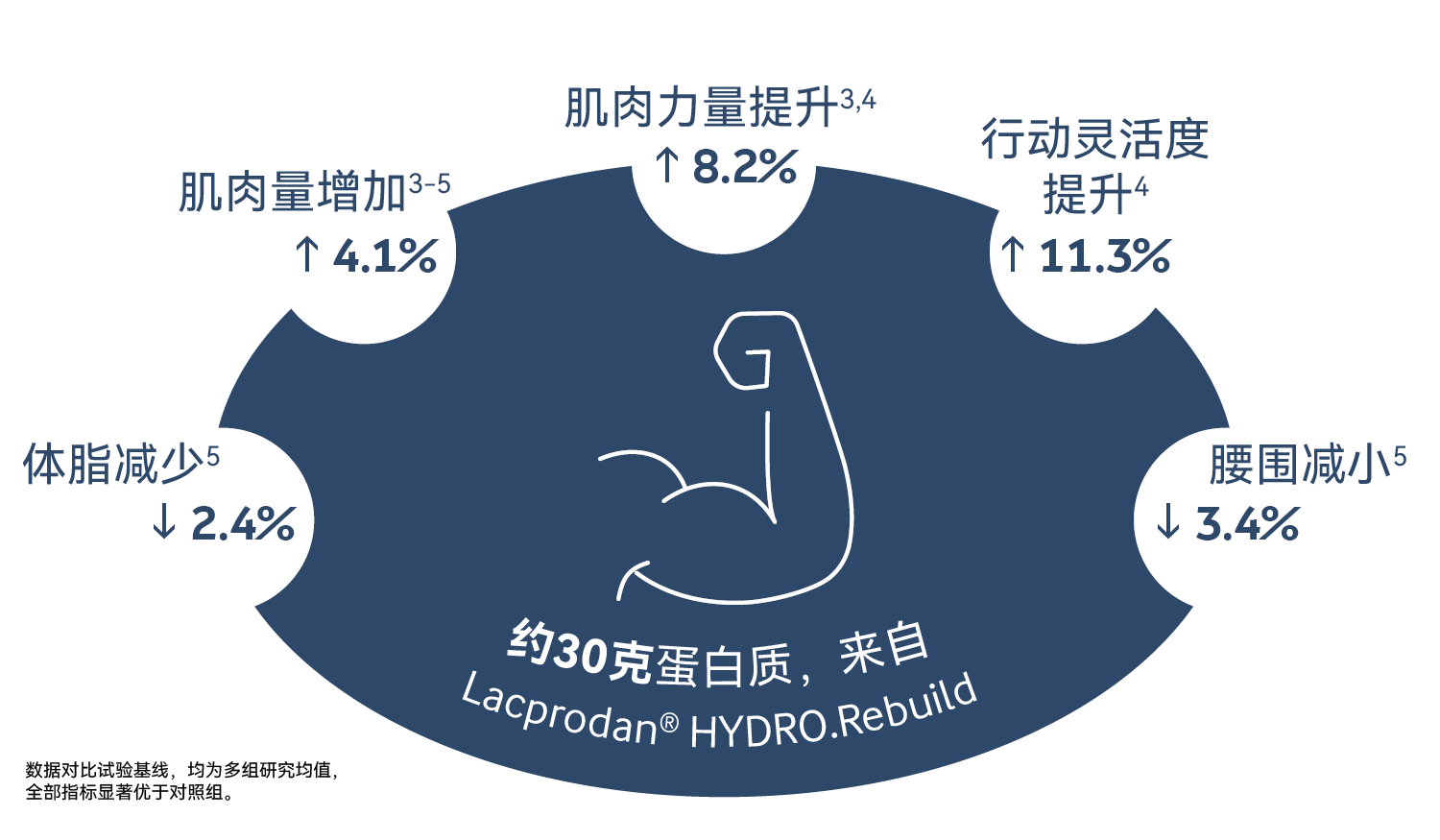
衰老会带来多项身体机能变化,其中之一便是肌少症,表现为骨骼肌量与肌肉功能自然衰退。肌少症可能严重影响人体行动能力、生活质量,甚至缩短预期寿命。 好消息是,日常补充乳清蛋白并配合规律锻炼,能够延缓肌肉量与肌力流失。三项独立人体临床试验3,4,5显示,在坚持抗阻训练的老年女性中,摄入阿拉食品原料的水解乳清原料 Lacprodan® HYDRO.Rebuild,有助于改善与肌少症相关的身体状况。
试验结果表明,摄入乳清的女性健康状况有显著改善,包括:
- 肌肉量增加
- 肌肉力量提升
- 行动灵活度提升
- 腰围减小
- 体脂减少
为何乳清如此特殊?相较于其他蛋白来源,乳清蛋白更能促进老年人肌肉合成6, 7, 8。核心原因在于其亮氨酸含量更高、吸收速度更快;同时能以人体易于消化吸收和利用的形式,提供全部必需氨基酸。
补充蛋白,维持强健体魄
目前,蛋白质的推荐膳食摄入量为每日每公斤体重 0.8 克;但很多老年人的蛋白质摄入量未达到建议水平。荟萃分析显示,约 20%的 老年人蛋白质摄入量低于推荐值,近半数人群未达到适配健康老龄化的较高摄入水平,即每天每公斤体重至少1.0克9。
优质蛋白搭配锻炼,对抗肌少症
越来越多科学证据表明,乳清蛋白可作为优质蛋白补充剂,帮助中老年人在衰老过程中维持肌肉量与肌力10。每日每公斤体重摄入至少 1.2克蛋白质,并保持积极活跃的生活方式,有助于减轻肌少症带来的影响¹¹。
质量胜过数量
常言说 “质优于量”,蛋白补充同样适用这一理念。评判蛋白质品质可采用可消化必需氨基酸评分(DIAAS),该指标综合体现蛋白质的氨基酸组成,以及人体对其的吸收利用率。评分达到 1 及以上,意味着该膳食蛋白质来源能够以易于消化和利用的形式,提供人体所需的全部必需氨基酸(EAA)。
另一种蛋白品质评价标准为蛋白质消化率校正氨基酸评分(PDCAAS),该体系满分上限为 1.0。评分达到 1.0 的蛋白原料,意味着每单位蛋白可满足甚至超额供给人体所需全部必需氨基酸。
这些评分表明,对比市面上常见膳食蛋白原料,乳清蛋白拥有更优质的蛋白品质12, 13, 14,15
常见蛋白质来源的蛋白质质量12, 13, 14, 15

1. United Nations Population Fund, UNFPA (Asia & The Pacific)
2. WHO 2026
3. Junior PS, Ribeiro AS, Nabuco HCG, et al. Effects of Whey Protein Supplementation. Associated With Resistance Training on Muscular Strength, Hypertrophy and Muscle Quality in Pre-Conditioned Older Women. Int J Sport Nutr Exerc Metab. 2017;(January):1-27. doi:10.1123/ijsnem.2017-0253.
4. Nabuco HCG, Tomeleri CM, Sugihara Junior P, et al. Effects of whey protein supplementation pre- or post-resistance training on muscle mass, muscular strength, and functional capacity in pre-conditioned older women: A randomized clinical trial. Nutrients. 2018;10(5):1-14. doi:10.3390/nu10050563.
5. Silva AM, Barbosa DS, Fernandes RR, et al. Effects of Protein Intake Beyond Habitual. Intakes Associated With Resistance Training on Metabolic Syndrome- Related Parameters, Isokinetic Strength and Body Composition in Older Women. J Aging Phys Act. 2019:1-25. doi:10.1123/japa.2018-0370.
6. Pennings B, Boirie Y, Senden JMG, Gijsen AP, Kuipers H, van Loon LJC. Whey protein stimulates postprandial muscle protein accretion more effectively than do casein and casein hydrolysate in older men. Am J Clin Nutr. 2011;93(5):997-1005. doi:10.3945/ajcn.110.008102
7. Burd NA, Yang Y, Moore DR, Tang JE, Tarnopolsky MA, and Phillips SM. Greater stimulation of myofibrillar protein synthesis with ingestion of whey protein isolate v. micellar casein at rest and after resistance exercise in elderly men. Br J Nutr. 2012 Sep 28;108(6):958-62.
8. Yang Y, Breen L, Burd NA, Hector AJ, Churchward-Venne TA, Josse AR, Tarnopolsky MA, Phillips SM. Resistance exercise enhances myofibrillar protein synthesis with graded intakes of whey protein in older men. Br J Nutr. 2012. pp. 1–9.
9. Hengeveld et al. Prevalence of protein intake below recommended in community‐dwelling older adults: a meta‐analysis across cohorts from the PROMISS consortium. J Cachexia Sarcopenia Muscle. 2020 Jun 16;11(5):1212–1222. doi: 10.1002/jcsm.12580
10.Li ML, Zhang F, Luo HY, Quan ZW, Wang YF, Huang LT, Wang JH. Improving sarcopenia in older adults: a systematic review and meta-analysis of randomized controlled trials of whey protein supplementation with or without resistance training. J Nutr Health Aging. 2024 Apr;28(4):100184. doi: 10.1016/j.jnha.2024.100184. Epub 2024 Feb 12. PMID: 38350303; PMCID: PMC12877251.
11.Deutz NE, Bauer JM, Barazzoni R, Biolo G, Boirie Y, Bosy-Westphal A, Cederholm T, Cruz-Jentoft A, Krznariç Z, Nair KS, Singer P, Teta D, Tipton K, Calder PC. Protein intake and exercise for optimal muscle function with aging: recommendations from the ESPEN Expert Group. Clin Nutr. 2014 Dec;33(6):929-36. doi: 10.1016/j.clnu.2014.04.007.
12.https://pubmed.ncbi.nlm.nih.gov/33133540/
13.Mathai JK, Liu Y, Stein HH. Values for digestible indispensable amino acid scores (DIAAS) for some dairy and plant proteins may better describe protein quality than values calculated using the concept for protein digestibility-corrected amino acid scores (PDCAAS). Br J Nutr. 2017;117(4):490-499. doi:10.1017/S0007114517000125.
14. Rutherfurd SM, Fanning AC, Miller BJ, Moughan PJ. Protein Digestibility-Corrected Amino Acid Scores and Digestible Indispensable Amino Acid Scores Differentially Describe Protein Quality in Growing Male Rats. J Nutr. 2015;145(2):372-379. doi:10.3945/jn.114.195438.
15. Bindari YR, Lærke HN, Nørgaard JV. Standardized ileal digestibility and digestible indispensable amino acid score of porcine and bovine hydrolyzates in pigs. J Sci Food Agric. 2018;98(6):2131-2137. doi:10.1002/jsfa.8697